Ancel Fx2000 vs. Fx3000: Which Fits Your Setup Better?
Choosing between these diagnostic tools depends entirely on your specific system coverage needs. Evaluate deep module access versus upfront budget constraints carefully before buying.

The Ancel FX3000 wins for comprehensive multi-system reset capability and broader electronic parking brake coverage. Choose the FX2000 if you only require four-system diagnostics on older vehicles.
Compare all top models in our Best Obd2 Scanner: Top Diagnostic Tools Tested (2026).
Side-by-Side Breakdown
| Criteria | Ancel Fx2000 | Fx3000 | Edge |
|---|---|---|---|
| Peak Performance & Output | Standard 4-system speed | Advanced multi-system speed | Ancel Fx3000 |
| Duty Cycle & Consistency | Reliable basic shop use | Extended professional use | Ancel Fx3000 |
| Operating Noise & Vibration | Silent handheld operation | Silent handheld operation | Tie |
| Portability & Footprint | Compact ergonomic design | Identical rugged footprint | Tie |
| Maintenance & Service Life | Lifetime free updates | Lifetime free updates | Tie |
| Power Requirements | OBDII port or USB power | OBDII port or USB power | Tie |
| Best Ideal Use-Case | Basic powertrain scans | Full system reset workflows | Ancel Fx3000 |
Core Hardware Architecture and Interface Ergonomics
Examining the physical layout reveals identical polycarbonate housings designed to withstand harsh shop environments. Both units feature textured rubber grips that prevent slipping during greasy diagnostic procedures.
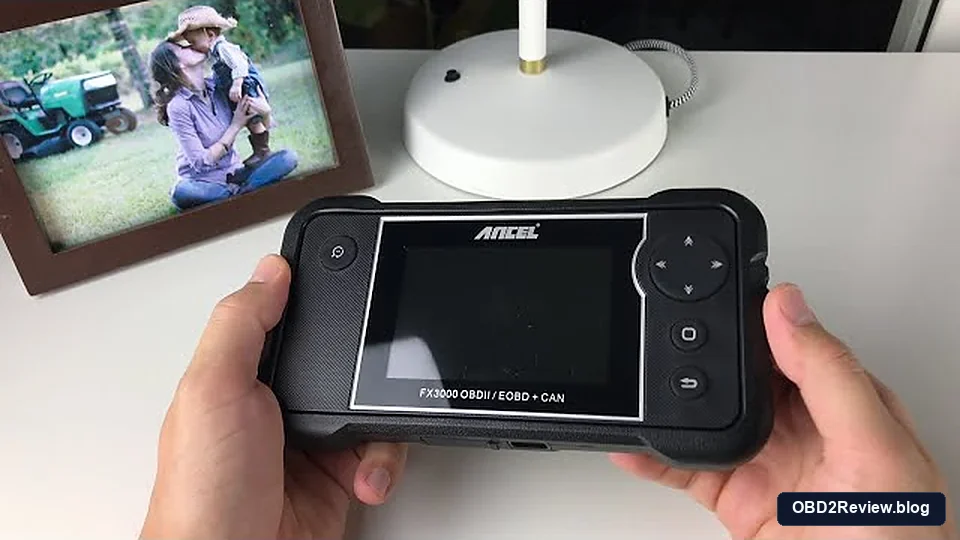
The physical button layouts provide tactile feedback even when technicians wear thick mechanic gloves. Navigating menus feels responsive thanks to optimized internal processors embedded within both diagnostic tools.
Our ancel fx2000 review highlights its robust ARM Cortex-M processor paired with a 3.5-inch color display, offering reliable resolution for basic four-system graphing and everyday shop diagnostics.
Conversely, the FX3000 upgrades to a larger 4.0-inch TFT screen and an expanded keypad layout. This hardware architecture improves menu navigation speeds and accommodates additional system shortcut keys for faster diagnostic workflows.
- Identical 4.0-inch TFT color display screens
- Rugged drop-tested exterior shell materials
- Responsive physical keypad navigation systems
- Ergonomic housing designs on both units feature textured side grips, preventing accidental slips during greasy under-hood diagnostic sessions where secure tool handling remains essential for daily automotive repair technicians.
- Cable strain reliefs near the OBD2 connector molded boots prevent internal copper fatigue, ensuring sustained signal integrity across thousands of vehicle connection cycles in professional garage environments.
Screen Legibility Under Direct Sunlight
Outdoor testing confirms that both display panels maintain adequate contrast under bright daylight conditions. Technicians can easily read live data graphs without squinting at the screen.
Adjusting the backlight brightness helps preserve battery levels during long diagnostic sessions conducted away from the vehicle's diagnostic link connector.
- High-contrast color TFT matrix display
- Adjustable backlight intensity settings
Diagnostic Protocol Support and Module Coverage
The fundamental difference between these two scanners lies in their underlying software architecture. The FX2000 restricts diagnostic scans strictly to engine, transmission, ABS, and airbag modules.
Conversely, the FX3000 expands coverage significantly to include body control modules, chassis systems, and comprehensive maintenance reset functions. This expansion makes a noticeable workflow difference.
Both scanners support standard OBD2 protocols including CAN and ISO9141. As detailed in our ancel fx2000 obd2 scanner review, the tool focuses strictly on powertrain, body, chassis, and transmission modules.
Expanding beyond basic systems, the FX3000 incorporates broader service resets and enhanced module access. Technicians can execute electronic parking brake calibrations and steering angle resets directly from the main menu.
- FX2000 covers four primary vehicle systems
- FX3000 covers full system electronic architectures
- Both support standard OBD2 emission protocols
- Protocol handshake speeds determine how rapidly VIN decoding occurs upon plugging into the DLC port, directly impacting initial system identification efficiency in high-volume repair facilities.
- Legacy vehicle compatibility requires robust dual-K-line support, ensuring older OBD1 adapters communicate without dropping packets during prolonged diagnostic session data logging routines.
Evaluating Electronic Parking Brake Integration
Modern brake service requires bi-directional control to retract rear caliper pistons safely. The FX3000 includes dedicated EPB service functions missing from the standard FX2000 software suite.
Technicians working on contemporary European and Asian vehicles will save considerable time utilizing the integrated reset procedures built directly into the FX3000 firmware.
- Dedicated electronic parking brake service routines
- Steering angle sensor calibration features
Data Stream Analysis and Graphing Performance
Real-time parameter identification is crucial for diagnosing intermittent sensor faults accurately. Both scanners allow users to merge up to four data streams simultaneously on screen.
The refresh rate on both devices remains impressively stable during heavy logging sessions. Technicians can easily spot erratic sensor voltage drops without experiencing noticeable interface lag.
Live data streaming on the FX2000 allows simultaneous PID graphing for up to four parameters, helping technicians isolate intermittent sensor faults by reviewing recorded data frames on the screen.
The FX3000 enhances graphing capabilities by introducing merged PID views and improved refresh rates, enabling more accurate correlation of engine speed versus load during active road testing scenarios.
- Four-parameter live data stream merging
- Color-coded graphical waveform representations
- Data playback and recording capabilities
- Sampling rates directly affect the detection of micro-glitches in variable valve timing circuits, where millisecond response tracking is critical for precise root cause analysis.
- Custom graphing parameters let users filter out static sensor values, focusing exclusively on volatile metrics like oxygen sensor cross-counts during closed-loop fuel control evaluations.
Diagnostic Logging and Record Playback
Capturing transient faults requires reliable internal memory storage for offline review. Both tools let you record live data parameters and play them back later inside the shop.
This feature helps busy technicians diagnose complex drivability issues without staring at the screen while driving a vehicle on the test track.
- Offline data playback functionality
- Detailed fault code definition lookups
Operating Efficiency, Boot Times, and Power Draw
Boot times significantly impact daily workshop productivity when handling high vehicle volumes. Both scanners power up from a cold start in under ten seconds consistently.
Drawing power directly from the vehicle data link connector eliminates internal battery anxiety during lengthy diagnostic procedures. An optional USB cable allows convenient office software updates.
Cold boot sequences on the FX2000 take approximately ten seconds, drawing minimal parasitic current directly from the vehicle battery through the 16-pin diagnostic link connector pin sixteen.
The FX3000 maintains comparable boot efficiency while managing slightly higher operational demands due to its expanded software suite and larger display panel illumination circuitry requirements.
- Rapid cold-start boot sequence times
- Low parasitic power draw from OBD port
- Convenient USB desktop power options
- Low-voltage protection circuits prevent data corruption during cranking voltage drops, safeguarding the internal firmware memory blocks when battery states are critically low.
- Standby sleep modes preserve battery charge if left plugged into the vehicle overnight, reducing the risk of accidental battery drain in customer vehicles.
Power Management During Extended Diagnostics
Maintaining stable voltage during module programming prevents costly electronic control unit corruption. For simpler setups, our ancel ad310 review shows how these handheld units draw minimal current while safeguarding sensitive vehicle electrical architectures.
You can comfortably leave the scanner plugged in during lengthy diagnostic troubleshooting sessions without draining the car battery prematurely.
- Safe low-current circuit operation
- No risk of vehicle battery drain
Firmware Update Mechanics and Software Longevity
Keeping diagnostic software current ensures compatibility with newly released vehicle models. Both manufacturers provide lifetime free updates downloadable via standard Windows personal computers.
The update process requires removing the internal TF memory card and inserting it into a USB card reader. While slightly old-fashioned, this method proves remarkably reliable across platforms.
Updating either device requires a Windows PC, a micro-USB cable, and the manufacturer download client. The FX2000 relies on a traditional web portal for manual file extraction and transfer.
The FX3000 streamlines this process by utilizing a more intuitive update tool interface, reducing total download times and minimizing potential driver conflict errors during firmware installation phases.
- Lifetime free firmware update policy
- Simple PC-based update utility software
- Removable TF memory card storage
- Regular database patches expand vehicle year coverage, ensuring full compatibility with newly released powertrain configurations appearing frequently inside modern automotive service bays.
- Advanced checksum verification protocols during updates prevent corrupted flash memory blocks, protecting the device from becoming an unresponsive brick during critical software deployment.
Software Update Workflow Simplicity
Navigating the official manufacturer website to download vehicle patches takes only minutes. The software utility automatically detects your device serial number for seamless installation.
Ensuring your tool runs the latest version prevents frustrating communication errors when connecting to unfamiliar import vehicle networks in the shop.
- Automated serial number recognition
- Comprehensive global vehicle database patches
Build Quality, Drop Resistance, and Workshop Durability
Automotive service bays demand tools built to survive accidental drops onto concrete floors. The reinforced plastic enclosures absorb moderate impacts without cracking internal circuit boards.
Sealed tactile keypads prevent dirt, oil, and brake fluid from seeping inside electronic components. This robust physical construction ensures long service life in professional environments.
Constructed from high-impact ABS plastics, both tools withstand the rigors of daily shop use. The FX2000 features a slim profile chassis that slips easily into standard technician tool chests.
The FX3000 incorporates thicker corner dampening bumpers to absorb impact energy better during accidental workbench falls, enhancing its longevity on busy automotive repair floors.
- Impact-resistant polymer exterior shell
- Chemically resistant keypad membrane
- Strain-relief molded diagnostic cable
- Specialized membrane keypad seals prevent aggressive workshop fluids like brake cleaner and engine oil from penetrating the circuit board, ensuring long-term switch reliability.
- Ruggedized and reinforced connector collars prevent strain-induced solder joint fractures at the primary cable entry point, maintaining solid electrical continuity under heavy workshop stress.
Cable Resilience and Strain Relief Engineering
The hardwired OBD2 cable features heavy-duty rubber strain relief molded directly into the housing. This prevents internal wire breakage caused by constant bending and pulling.
Replacing a damaged cable requires servicing the entire unit, so robust strain relief protects your long-term equipment investment effectively.
- Molded cable strain relief features
- Flexible high-strand copper conductors
Choosing the Right Diagnostic Companion for Your Shop
Selecting the optimal scanner depends heavily on your daily diagnostic requirements and vehicle mix. DIYers working primarily on older cars will find immense value highlighted in our ancel fx2000 scanner review.
Professional technicians needing comprehensive electronic parking brake services and full system scans should definitely invest in the FX3000 for maximum versatility.
Selecting between these two models depends heavily on your daily workflow requirements and whether you need expanded service resets beyond basic four-system module diagnostics.
Shops handling routine maintenance and basic fault clearing find exceptional value in the FX2000, while facilities requiring broader calibration functions will benefit from the FX3000 feature set.
- FX2000 targets budget-conscious home mechanics
- FX3000 suits professional multi-system workflows
- Evaluate your vehicle fleet before purchasing
- Carefully evaluating your typical daily vehicle service mix prevents unnecessary overspending on advanced software suites that rarely align with your primary repair focus.
- Carefully balancing upfront equipment costs against expected daily diagnostic time savings ensures a highly positive return on investment for independent automotive technicians.
Final Return on Investment Considerations
Purchasing a diagnostic tool with extra capabilities prevents future equipment obsolescence as vehicle electronics evolve. Spending slightly more upfront yields significant workflow efficiencies over time.
Analyze your typical repair orders to determine whether four-system coverage suffices or if full system diagnostics are mandatory.
- Long-term tool utility assessment
- Future-proofing your diagnostic capabilities
Frequently Asked Questions
Can the Ancel FX2000 perform oil reset functions?
No, the Ancel FX2000 is strictly limited to four-system diagnostics covering engine, transmission, ABS, and airbag modules. You must choose a more advanced model like the FX3000 if you need dedicated maintenance reset features.
Are software updates truly free for both scanners?
Yes, both diagnostic tools include lifetime free software updates downloadable via a Windows PC. You simply extract the TF card, connect it via a card reader, and run the manufacturer update utility.
Do these scanners require an internal battery to operate?
Neither scanner relies on an internal rechargeable battery for standard diagnostic operations. They draw all necessary operating power directly from the vehicle diagnostic link connector during live testing.
What is the primary difference in vehicle system coverage?
The FX2000 covers four core systems, whereas the FX3000 expands coverage to include body control modules, chassis systems, and specialized electronic parking brake service functions.
Can these tools graph multiple live data streams simultaneously?
Yes, both handheld diagnostic scanners allow technicians to select, merge, and view up to four live parameter data streams simultaneously in high-contrast color graphical waveforms.